Loading stats...
Sudoku
About Sudoku
Sudoku is a number-placement logic puzzle built around pattern recognition and careful deduction. Each completed puzzle feels satisfying because progress comes from noticing relationships between rows, columns, and 3x3 boxes rather than from luck.
On CardGamesHub.io, Sudoku is designed to be easy to jump into: open the page, start solving in your browser, and enjoy a clean puzzle experience without downloads. It is a different style of game from our card titles, but it fits the same goal of offering classic games that are simple to learn and rewarding to master.
On CardGamesHub.io, Sudoku sits alongside Cribbage and Solitaire as one of our classic puzzle and card game experiences. Whether you prefer logic puzzles or card games, all three are available to play in your browser without any downloads.
Quick Facts
| Grid size | 9 x 9 cells |
| Total cells | 81 |
| Boxes | 9 (each 3 x 3) |
| Minimum clues for unique solution | 17 |
| Origin | United States, 1979 |
| Popularised in Japan | 1984 by Nikoli |
How to Play Sudoku
Objective
Fill the 9x9 grid so that every row, every column, and every 3x3 box contains the digits 1 through 9 exactly once.
Grid Rules
- Each row must include the numbers 1 to 9 with no repeats.
- Each column must include the numbers 1 to 9 with no repeats.
- Each 3x3 box must include the numbers 1 to 9 with no repeats.
The numbers are symbols, not arithmetic values, so you are not adding or subtracting them.
Starting Clues
Every Sudoku puzzle begins with some cells already filled in. These starting clues are fixed and cannot be changed. Your job is to use them to deduce the missing numbers.
Difficulty Guide
| Typical Clues | Skill Level | Techniques Used |
|---|---|---|
| 36-50 | Easy | Naked singles, scanning |
| 27-35 | Medium | Hidden singles, basic elimination |
| 22-26 | Hard | Naked pairs, intersection removal |
| 17-21 | Expert | X-wings, chains, advanced methods |
Step-by-Step Play
- Scan a row, column, or box and note which digits are already present.
- Look for an empty cell where only one number can legally fit.
- Use intersections between rows, columns, and boxes to narrow down candidates.
- Repeat the process, building certainty from the clues already on the board.
Many players also think in terms of pencil marks, meaning a short mental or written list of possible digits for a square while they reason through the puzzle.
Winning the Puzzle
You solve the puzzle when all 81 cells are filled and the finished grid obeys the row, column, and box rules with no duplicates anywhere.
Sudoku Tips and Strategies
Strong Sudoku play is mostly about staying systematic. These habits can help you solve puzzles faster and with fewer avoidable mistakes.
Beginner Strategies
1. Scan for Naked Singles
A naked single is a cell where only one digit can legally fit. It is the most common entry point for beginners and the first place to look on any board.
- Check every empty cell for eliminated candidates.
- If only one number remains possible in a cell, fill it in.
- Repeat the scan after each placement.
2. Work the Crowded Areas First
Rows, columns, and boxes with more clues give you more information to work from.
- Identify which units are closest to complete.
- Use the known digits to eliminate options in nearby empty cells.
- Save less-populated areas for later when you have more context.
Intermediate Strategies
3. Find Hidden Singles
A hidden single is a digit that can only go in one cell within a row, column, or box even if that cell appears to have multiple candidates.
- Scan each box for digits that fit in only one position.
- Do the same across every row and column.
- Hidden singles often appear after naked singles are cleared.
4. Use Pencil Marks
Writing candidate digits in empty cells helps you track possibilities without committing to a wrong answer.
- Note every possible digit in each unsolved cell.
- Cross out candidates as you fill in nearby cells.
- Pencil marks turn a memory task into a visual scanning task.
Advanced Strategies
5. Spot Naked Pairs and Triples
When two cells in the same unit share exactly the same two candidates, those digits can be removed from every other cell in that unit.
- Look for two cells with identical two-candidate sets.
- Eliminate those candidates from the rest of the row, column, or box.
- Triples work the same way with three cells and three shared candidates.
6. Apply Intersection Removal
If a digit in a box can only appear in one row or column within that box, it can be removed from the rest of that row or column outside the box.
- Find a box where a digit is confined to a single row or column.
- Remove that digit as a candidate from cells in the same row or column outside the box.
- This technique often unlocks regions that appeared stuck.
Common Mistakes
These are the errors that trip up players at every level.
| Mistake | What Happens | How to Fix |
|---|---|---|
| Guessing too early | Creates contradictions that are hard to trace later | Keep eliminating candidates until a placement is logically certain |
| Ignoring a unit after filling it | Misses ripple eliminations in connected rows, columns, and boxes | Re-scan connected units every time a cell is confirmed |
| Skipping pencil marks on hard puzzles | Forces reliance on memory, leading to avoidable errors | Use candidate notation from the start on medium or harder puzzles |
| Treating Sudoku as arithmetic | Over-complicates decisions that are purely positional | Remember that digits are symbols, order and value are irrelevant |
Do's and Don'ts
Do
- Scan all rows, columns, and boxes before placing any digit.
- Use pencil marks on medium and hard puzzles.
- Re-scan the full board after every confirmed placement.
- Start with areas that have the most clues already filled.
- Check your work if a row or column starts to feel impossible.
Don't
- Guess unless you have exhausted all deductive options.
- Focus on only one area of the board for too long.
- Assume a digit fits without checking its row, column, and box.
- Ignore pencil marks once you have written them, update them.
- Rush the final cells, the last few placements are where errors hide.
Ready to practice? Jump back to the Sudoku board and apply these ideas one step at a time.
Further Reading
These resources go deeper on solving techniques and puzzle variety:
History of Sudoku
Sudoku is one of the most widely recognized logic puzzles in the world, but its origins stretch across several centuries and more than one country.
Latin Squares and Early Origins
The mathematical idea behind Sudoku predates the modern puzzle by centuries. Leonhard Euler studied Latin squares in the 18th century: grids in which each symbol appears exactly once in every row and column. Sudoku extends that idea by adding the constraint that each 3x3 box must also contain each symbol exactly once.
Number Place (1979)
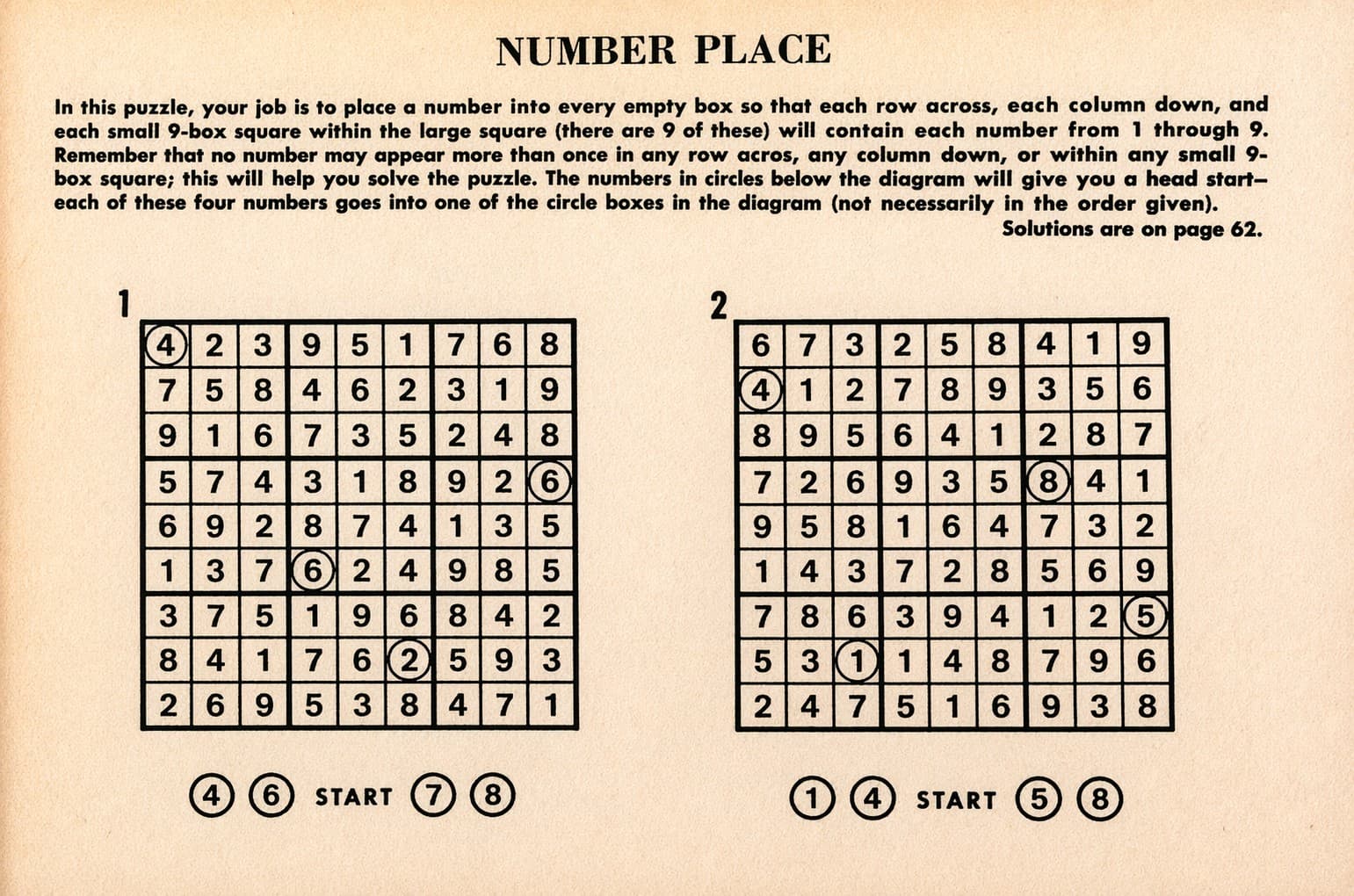
The specific format that became Sudoku was created by Howard Garns, a retired American architect, and published under the title Number Place in Dell Pencil Puzzles and Word Games magazine in 1979. Garns combined the Latin square structure with 3x3 box constraints to create a puzzle that could be solved purely through logic.
Nikoli and the Name Sudoku (1984)
Japanese publisher Nikoli introduced the puzzle to Japan in 1984 under the name Suuji wa dokushin ni kagiru, which translates roughly as the digits must remain single. The name was shortened to Sudoku for practical use. Nikoli refined the format, added design rules such as requiring rotational symmetry, and built a dedicated readership through its puzzle magazines.
Global Boom (2000s)
Sudoku spread internationally in the mid-2000s when newspapers in the United Kingdom and beyond began publishing it daily. Software, websites, and later mobile apps made the puzzle accessible to billions of casual players. It became one of the most published logic puzzles in history and remains a staple of puzzle books, apps, and newspapers worldwide.
Sudoku Milestones
| Year | Event |
|---|---|
| 1782 | Leonhard Euler publishes research on Latin squares, an early mathematical precursor. |
| 1979 | Howard Garns creates Number Place, published in Dell Pencil Puzzles and Word Games. |
| 1984 | Nikoli introduces the puzzle to Japan as Sudoku and refines its design rules. |
| 1986 | Nikoli introduces the requirement for rotational symmetry in puzzle grids. |
| 2004 | The Times of London begins publishing Sudoku daily, sparking a worldwide newspaper craze. |
| 2005 | Sudoku reaches mainstream popularity across Europe, North America, and Australia. |
| 2010s | Mobile apps bring Sudoku to smartphones, making it one of the most downloaded puzzle game categories. |
Further Reading
For more on the history and mathematics of Sudoku:
Frequently Asked Questions
If you are learning Sudoku for the first time or trying to solve puzzles more confidently, these quick answers cover the most common questions players run into.
Credits and Acknowledgments
This Sudoku page brings together the playable puzzle experience on CardGamesHub.io with editorial content designed to help new and returning players enjoy the game more confidently.
Historical and Editorial References
The educational background for this page was informed by reference material from Britannica and Nikoli, especially for the historical context around Number Place and the popularization of Sudoku.
Platform Experience
Thanks to everyone contributing to the CardGamesHub platform and the embedded Sudoku experience that powers this page.
Image Credits
The Number Place historical image is shown from MathPuzzle.com's Sudoku Variations article, which documents the first published Number Place puzzles from Dell Pencil Puzzles and Word Games.
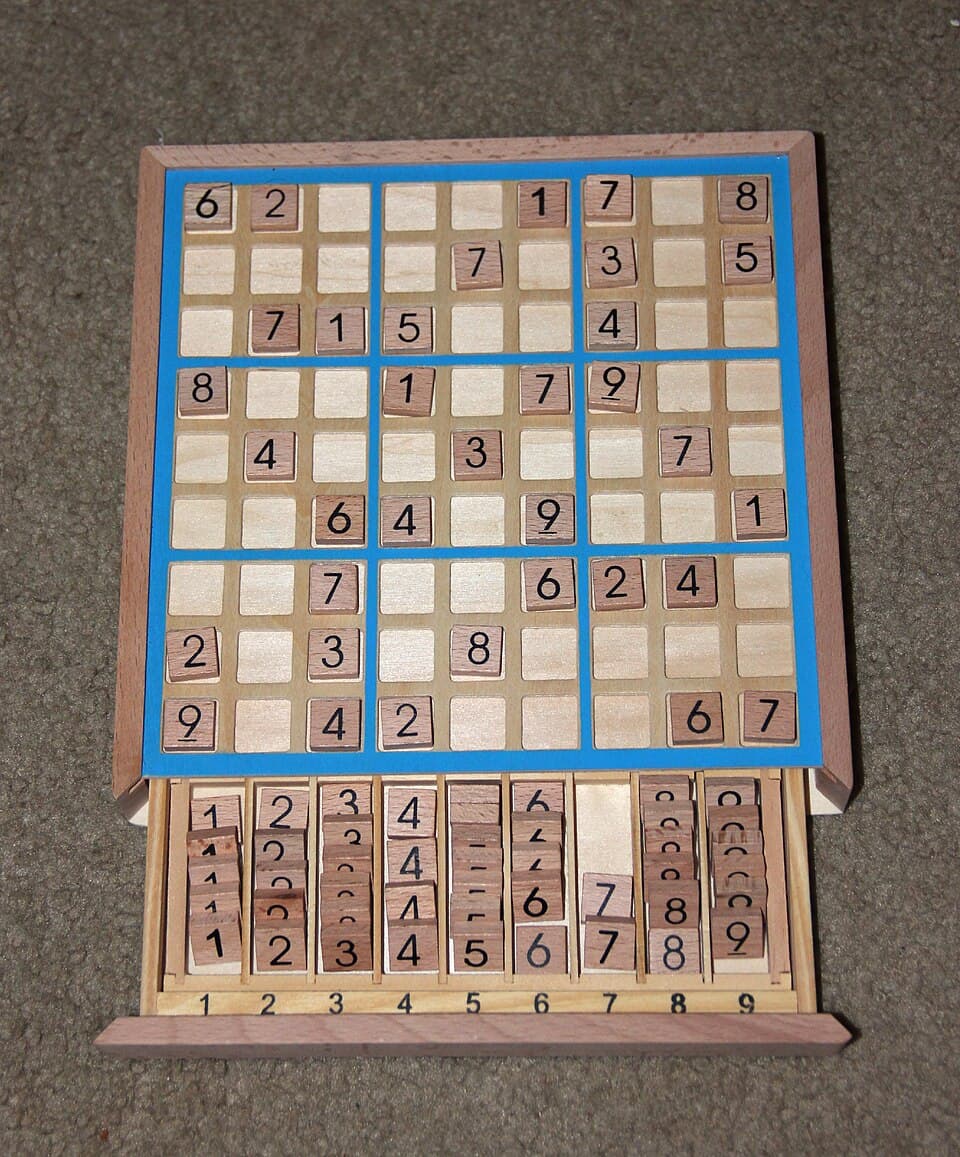
The physical board photo is Sudoku board game.jpg by Catboy69 on Wikimedia Commons, licensed under CC0 1.0.
Explore More on CardGamesHub
Looking for more to play? Solitaire and Cribbage are also available on CardGamesHub.io.