Spider Solitaire
About Spider Solitaire
Spider Solitaire is one of the most challenging and rewarding card games ever created. Played with two standard decks (104 cards) across ten tableau columns, your goal is to build eight complete suit sequences from King down to Ace and clear them all to win. Unlike simpler solitaire games, Spider rewards patience, planning ahead, and careful sequencing across every move.
On CardGamesHub you can play free Spider Solitaire online with no download, no signup, and no ads blocking your view. The game runs instantly in your browser, works on desktop and mobile, and is available unblocked on any network. Whether you're here to relax with a manageable challenge or test yourself at the hardest setting, the full game is right here.
Spider Solitaire joins our collection of free card games including Klondike Solitaire, FreeCell, Cribbage, and Sudoku, all playable in your browser without any installation.
How to Play Spider Solitaire
Spider Solitaire uses two standard 52-card decks (104 cards in total). Here is the complete setup and rules.
Game Setup
- Ten tableau columns are dealt at the start. The leftmost four columns receive 6 cards each; the remaining six columns receive 5 cards each.
- Only the top card of each column is face-up. The remaining 44 cards are face-down, waiting to be revealed.
- The stockpile holds the 50 cards not dealt to the tableau. These are drawn in rounds of 10, one card per column, when you choose to deal.
Moving Cards
- Any suit, descending order: A single card may be placed on top of any card that is exactly one rank higher, regardless of suit. (Example: the 7 of Hearts can go on the 8 of Clubs.)
- Same-suit sequences only move as a group: A run of cards can only be picked up and moved together if every card in the run shares the same suit and is in descending order. (Example: 9♠ 8♠ 7♠ moves as a unit.)
- Natural builds matter: Building sequences in the same suit, called natural builds, is essential strategy. Mixed-suit sequences block future moves.
- Empty columns: A column becomes empty when all its cards are moved away. Any card or valid sequence can be placed into an empty column. Empty columns are your most valuable resource.
The Stockpile
- Ten cards are dealt from the stockpile at once, one face-up card added to the top of each tableau column.
- You can only deal from the stockpile when every column has at least one card. If any column is empty, fill it before dealing.
- Stockpile deals cannot be undone. Use them only when no useful tableau moves remain.
Winning the Game
- When you complete a full sequence from King down to Ace in a single suit (13 cards), that sequence is automatically removed to the foundation.
- Complete all eight foundation sequences to win.
Game Variants: 1 Suit, 2 Suits, and 4 Suits
Spider Solitaire comes in three variants, each using the same rules but a different mix of suits. The variant you choose changes how freely you can move cards around the tableau and how demanding the game becomes.
| Variant | Suits in Play | Mixed-suit stacks move as a group |
|---|---|---|
| 1 Suit | Spades only | Yes |
| 2 Suits | Spades + Hearts | No |
| 4 Suits | All four suits | No |
1 Suit
All 104 cards belong to a single suit, typically spades. Because every card shares the same suit, any descending run you build can be moved as a group from the start. This makes 1-suit Spider the most accessible variant and the best starting point for learning the game's core mechanics.
2 Suits
Cards are drawn from two suits, typically spades and hearts. Mixed-suit descending runs can be stacked but cannot move as a group, so building same-suit sequences requires more deliberate planning. A meaningful step up from 1-suit.
4 Suits
All four suits are in play, making natural builds much harder to achieve. Every card of a different suit placed on a run locks that stack in place. Managing the tableau without sacrificing empty columns becomes the central challenge, and a clean finish requires careful planning from the very first move.
Useful Links for Learning Spider Solitaire
If you prefer reading, here are some detailed guides that cover Spider Solitaire rules and strategy:
- How to Play Spider Solitaire: The Best Guide for All Levels - Pogo
- How to Play Spider Solitaire: Rules and Winning Strategies - Solitaire Bliss
- Mastering Spider Solitaire Rules: A Beginner's Guide - 247 Spider Solitaire
- How to Play Spider Solitaire (4 Suits) - BVS Solitaire
- How to Play Spider Solitaire: Rules, Setup and Strategy - Art of Cards
How to Play Spider Solitaire: Video Playlist
Spider Solitaire Strategy and Tips
Build Same-Suit Sequences First
Mixed-suit descending runs look useful but quickly become dead weight. Prioritize building natural sequences, cards of the same suit in descending order, from the earliest possible move. These are the only sequences you can move as a unit, giving you far more flexibility as the tableau fills up.
Protect Empty Columns
An empty column is the most powerful position in Spider Solitaire. Do not fill it with the first available card. Treat it as temporary storage for Kings, long sequences, or cards you need to unbury. The player who manages empty columns well wins far more games.
Prioritize Revealing Hidden Cards
In the opening phase, your primary goal is to flip face-down cards. Every revealed card expands your options. Focus your early moves on the columns with the most face-down cards, even if it means making imperfect builds elsewhere.
Use the Stockpile as a Last Resort
Dealing from the stockpile adds a card to every column, including any empty ones you have worked hard to create. Deal only when you are truly out of useful tableau moves. Premature stockpile deals can bury essential cards and seal off sequences you were building.
Look for the Waterfall Effect
Sometimes a single move triggers a chain reaction: flipping a card reveals a sequence you can move, which exposes another card, which unlocks another column. Scan the tableau for these cascade opportunities before settling on any individual move. The waterfall effect can clear a congested board in just a few turns.
Think in Sequences, Not Moves
Every move should serve a longer plan. Before placing a card, ask: does this contribute to a natural build? Does it reveal a hidden card? Or does it just shift the problem elsewhere? Reactive play, moving cards without a plan, leads to dead boards quickly.
Do's and Don'ts
Do
- Build same-suit sequences whenever a choice exists.
- Prioritize moves that flip face-down cards.
- Keep at least one column empty as long as possible.
- Scan the full tableau before dealing from the stockpile.
- Use empty columns to temporarily reorganize stacks.
- Plan several moves ahead before committing to a long build.
Don't
- Fill an empty column unless you have a clear purpose for it.
- Deal from the stockpile while any column is empty.
- Build mixed-suit runs when a same-suit alternative exists.
- Move cards just to move them without revealing or reorganizing.
- Ignore the face-down card count in each column.
- Assume the game is lost before exhausting all available moves.
Useful Links for Spider Solitaire Strategy
If you prefer reading, here are some detailed strategy guides:
Spider Solitaire Strategy: Video Playlist
A Brief History of Spider Solitaire
From Card Tables to Card Games
Patience games, the family of single-player card games to which Spider Solitaire belongs, were a fixture of aristocratic life across 18th- and 19th-century Europe. In Venetian palazzos, English parlors, and French salons, card play occupied idle hours between social engagements, with elaborate tables dressed for the occasion.
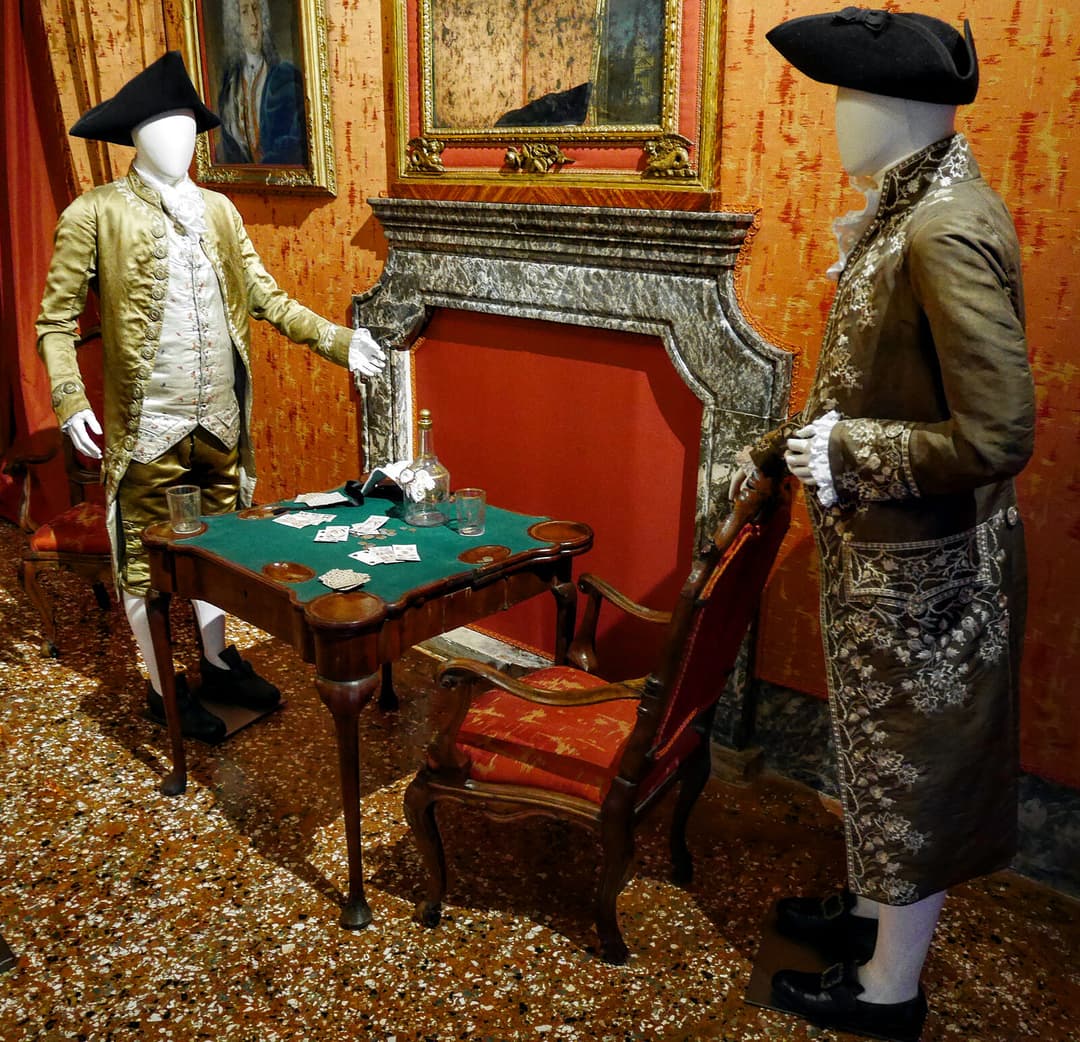
Spider Solitaire as a distinct game is believed to have emerged in the early 20th century, drawing on earlier two-deck patience formats. The name refers to the eight foundation piles required to win, one for each leg of a spider. Early printed rules appeared in card game compendiums by the 1940s, though the game's precise origins remain debated among card game historians.
The Microsoft Effect
Spider Solitaire reached a global audience when Microsoft bundled it with Windows XP in 2001. The version shipped with XP introduced the three-difficulty format of 1-suit, 2-suit, and 4-suit modes to hundreds of millions of computers worldwide.
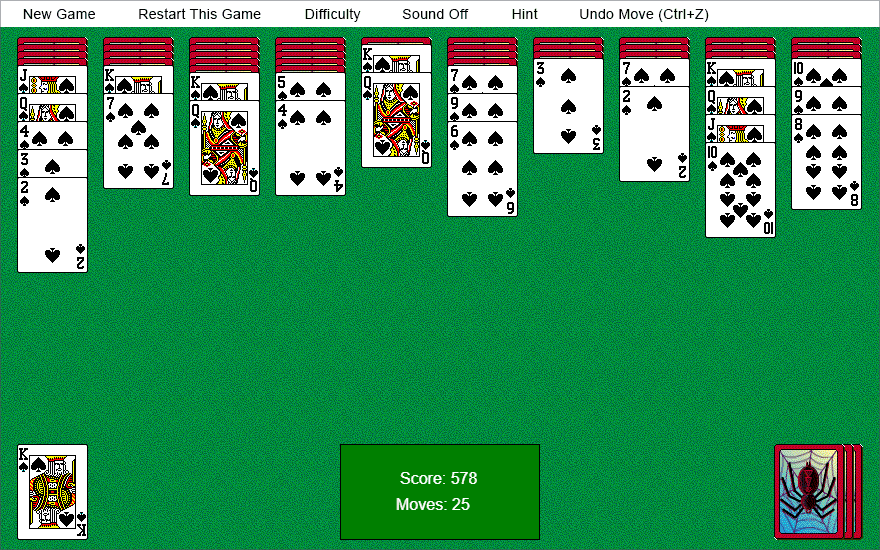
Its interface was deliberately simple: a green baize background, a compact toolbar, and the satisfying cascade animation when a completed suit was removed. For many players, this is still the version they picture when they hear Spider Solitaire.
Spider Solitaire Goes Online
As browser technology matured and Flash gave way to modern JavaScript, Spider Solitaire migrated from the desktop to the web. Today it is one of the most-searched card games online, with dozens of platforms offering free browser-based versions, including this one. Modern web implementations like CardGamesHub's Spider Solitaire preserve the classic mechanics while adding features such as unlimited undo, smart hint systems, and instant play without downloads or accounts.
Useful Links on Spider Solitaire History
If you prefer reading, here are some resources covering the history and background of Spider Solitaire:
Spider Solitaire: Frequently Asked Questions
Common questions about how to play, win, and access Spider Solitaire online.
Credits & Acknowledgements
Spider Solitaire on CardGamesHub is built on several open-source projects and original research. We're grateful to the following authors and communities.
Source Ledger
| Source | Used For | Why |
|---|---|---|
| PLSpider by "bar" | 4-suit game catalog | An open C solver (2004) used to verify and import solvable 4-suit seeds; the hardest variant requires exhaustive search beyond our TypeScript solver's scope. |
| CardGamesHub Spider Solver | 1-suit and 2-suit game catalogs | Custom TypeScript best-first search solver used to pre-verify all numbered 1-suit and 2-suit games as solvable. |
| SVG Playing Cards — Adrian Kennard (RevK) | Card face graphics | CC0 public domain SVG playing cards with court cards based on 19th century Goodall & Son designs, used across all CardGamesHub card games. |
| Palazzo Mocenigo, Venice (via CityScrolls) | History section image | 18th-century Venetian card table scene with period aristocratic costume, photographed at Palazzo Mocenigo museum, Venice. |
| Spider Solitaire on Windows XP (via Squidbyte) | History section image | Screenshot of Spider Solitaire as shipped with Microsoft Windows XP, used for historical reference. |
Enjoy other free card games on CardGamesHub: Klondike Solitaire, FreeCell, Cribbage, and Sudoku.